How to make your salary last till month end
By Samuel Anwakang, Co-founder of Delight•Updated
A salary runs out early when the whole month's money is spendable from day one. Fund your fixed costs on payday, before any spending, then release everyday money in daily or weekly amounts. The last week then has money, because the first week couldn't take it.
Why a salary finishes early
A bank balance tells you how much money is in the account. It doesn't tell you how much of it is already needed for bills that haven't come due.
Say your balance is ₦85,000 on the 10th. It feels like ₦85,000 you can use. But ₦50,000 of it needs to go towards rent, next week's transport costs ₦12,000 and your data renews in three days for ₦6,000. What you can actually spend is ₦17,000.
That gap between the balance and the real number is where salaries "finish". People spend against the balance they can see, not against what the money is already meant for. The money was never free. It only looked free.
It isn't only you. Research on monthly payments finds that spending on things like eating out jumps on the day money arrives, even when the date and amount are known in advance.[1]
The small payments add up in the same way: ₦1,800 for lunch, ₦3,500 for a ride because the bus queue was long, a third ₦2,000 airtime top-up this week. Each one made sense when you made it. None of them knew about the others.
Why tracking alone doesn't fix it
The usual advice is to track every expense. Tracking tells you what already happened. It can show a pattern, but it doesn't stop the next payment: you still see ₦85,000 in the account, and by the time you review the spreadsheet on Sunday, the money is gone.
It also takes effort that competes with life. Two weeks in, the spreadsheet stops getting updated. A fix has to act before the spending, not after it.
What makes a salary last, with or without Delight
- On payday, list what the month must pay for: rent (or what you're setting aside for it), bills, transport to work, family support, any repayments, and savings.
- Fund those first, before any everyday spending. They're decided once, on payday, instead of competing with every purchase.
- Divide what's left by the days to next payday. That's your everyday amount. ₦99,000 over 30 days is ₦3,300 a day.
- Release it in portions, daily or weekly, so the end of the month isn't funded by whatever the start didn't spend.
- Let a cheap day roll forward. Money you don't spend today makes tomorrow bigger, not the balance vaguer.
- Look back once a month. Move the amounts to fit what really happened, then run the same order again.
Set it up in Delight
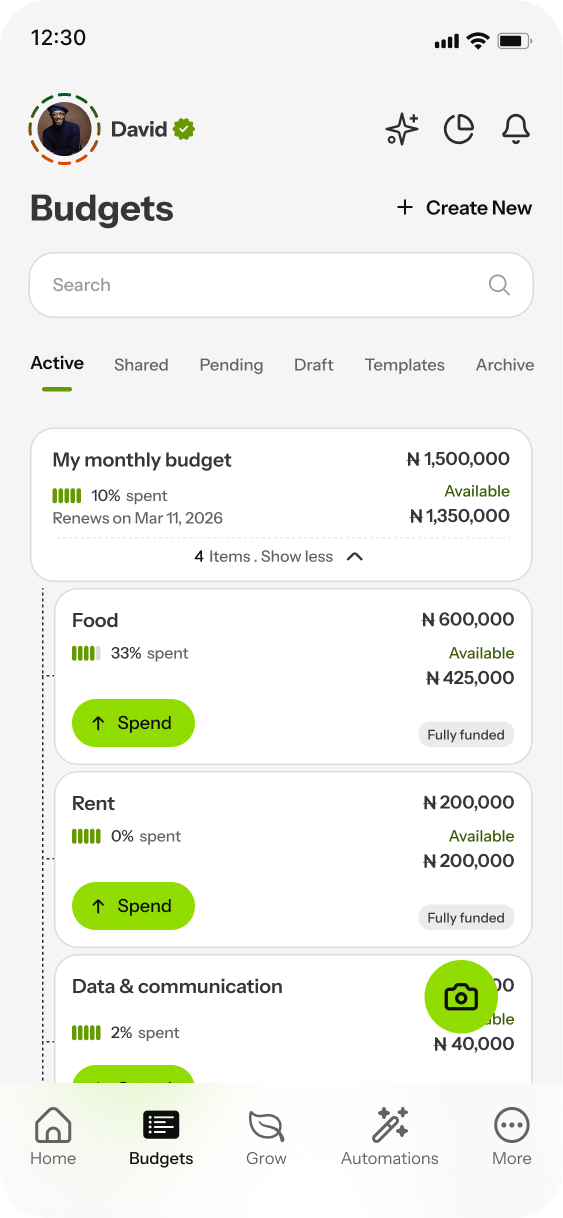
- Create a budget for each fixed cost: Rent, Bills, Transport, Family, Savings. Keep them together in a group called "Monthly", with each one as a sub-budget, so the month is on one screen.
- Add an Everyday budget for food, airtime and small spending.
- Set the funding order. Auto-funding moves money into your budgets as soon as it arrives in your wallet; check that Auto-fund is enabled on each budget. Then open a budget's menu, tap Funding priority, and put fixed costs at the top and Everyday at the bottom.
- Put drip mode on Everyday. Choose a daily amount. Only the day's Available Drip can be spent, and it can't be exceeded, so day 28 has the same amount as day 3. Choose Roll over to next Drip so unspent money carries to tomorrow.
- Pay from the budget the payment is for. Transfers and bills leave from a budget, so each payment comes out of its purpose and the tracking happens by itself.
- Automate what repeats: electricity, data, family support. Delight warns you about 30 minutes before a payment if the budget won't cover it.
- Decide what happens to leftovers. For each repeating budget, choose Rollover to Next Period, Fresh Start + Surplus or Return to Wallet.
Or set it up in one message
Send this to Delight AI in the app. It asks for your amounts, shows every step and waits for your approval.
Help me make my salary last till month end. Set up budgets for my fixed costs and my everyday spending, and put a daily drip on everyday spending. Ask me for my salary, my payday and the amounts.
Delight AI is off until you turn it on in Settings › Customize › Delight AI. Anything that sends money out asks for your transaction PIN.
What Delight can’t do
- Delight can't make a salary bigger. If your fixed costs are more than you earn, the plan shows the exact shortfall so you can decide what changes.
- It doesn't decide your amounts. You choose what each budget gets and can change it any time.
- Drip mode is your choice. You can switch it off at any time, with no penalty.
Questions people ask
- Why does my salary finish before month end?
- Usually because the whole salary sits in one balance from payday, so early spending uses money that later bills and days were meant to have. The balance looks free even when most of it is already needed for rent, bills and transport.
- How do I stop living paycheck to paycheck?
- Start by making each payday fund the whole month in order: fixed costs first, then everyday spending released in portions. Once a month ends with money left, move that leftover into a buffer budget, so the next month doesn't depend on payday arriving on time.
- My salary is not enough. What can I do?
- First find out if it's truly not enough or just spent in the wrong order. Add up your fixed costs and a realistic daily amount for food and transport. If that total is bigger than your salary, the gap is a real number: it tells you how much to cut, negotiate or earn. If it's smaller, the order of spending is the problem, and a payday setup fixes it.
- How do I manage a small salary?
- The smaller the salary, the more the order matters. Fund rent, transport to work and bills first, then divide what's left into a daily amount. A small daily amount you can see is easier to live on than a lump sum that disappears in a week.
- Should I save first or pay bills first?
- Fund what can't be skipped first: rent, bills, transport to work and any repayments. Then put a fixed amount into savings before everyday spending starts. Saving whatever is left at the end rarely works, because nothing is left.
- What if I'm paid weekly or my income changes?
- Use the same order on each payday, just for a shorter period. If your income changes month to month, build your fixed budgets around the lowest amount you reliably earn, and treat anything above it as extra. See how to make your money last until your next payment and how to budget on irregular income.
For your situation
Read next
Sources
- [1]Jr., M. S. (2003). “3rd of tha Month”: Do Social Security Recipients Smooth Consumption Between Checks?. American Economic Review, 93(1), 406–422.Setting: US (Consumer Expenditure Survey diaries).
- [2]Aguila, E., Kapteyn, A., & Perez-Arce, F. (2017). Consumption Smoothing and Frequency of Benefit Payments of Cash Transfer Programs. American Economic Review, 107(5), 430–435.Setting: Mexico (older adults' pension programmes).
- [3]Cheema, A., & Soman, D. (2008). The Effect of Partitions on Controlling Consumption. Journal of Marketing Research, 45(6), 665–675.Setting: Lab studies.
Plan the money. Fund the plan. Spend from the plan.
In Delight, each purpose is a budget that holds its own money, and every payment comes from the budget it serves.