Why am I always broke after payday?
By Samuel Anwakang, Co-founder of Delight•Updated
If you're broke soon after payday, the money usually wasn't missing. It was unassigned, and money without a purpose gets spent by whatever comes first. Give each naira a purpose on payday, hold that money apart, and pay from those purposes. Then you can see exactly where last month went.
The money wasn't missing. It was unassigned
On payday, the whole salary lands in one place with no labels on it. Rent, food, transport, family, bills and the weekend all draw from that one number. Money without a purpose gets spent by whatever asks for it first: the vendor who messages today, the friend who calls, the delivery app at 9pm.
People naturally sort money into categories like housing and food, and those budgets shape what they spend.[1] But when the sorting only happens in your head, the account can't enforce it.
By the 15th, you can account for the big payments. The rest happened in pieces too small to notice, each against the same balance. That's why "where did it go?" feels impossible to answer. The account recorded every payment, but none of them were recorded against what the money was meant for.
Why "not sure" is its own answer
When people start setting up Delight, we ask how they feel about their finances. Half say stressed, and about a third say they're not sure.[2]
"Not sure" is worth taking seriously. If you can't tell whether you're doing well, the numbers aren't visible enough to judge. You can't change what you can't see.
It's a national pattern, not a personal failing: 62% of Nigerian adults say emergency money would be very difficult to raise.[3]
How to see where the money goes, with or without Delight
- Do one honest month. Take last month's statement and group every payment by purpose: rent, food, transport, family, bills, data and airtime, enjoyment. Don't judge it; just total it.
- Name your purposes for this month, using those totals as a starting point.
- On payday, give each purpose its amount before spending anything. Whatever is left becomes everyday money, released in portions.
- Pay from the purpose. If you're using separate accounts or envelopes, pay rent from the rent account and buy food from the food envelope.
- At month end, compare the plan with what happened, and move the amounts. The second month is always more accurate than the first.
Set it up in Delight
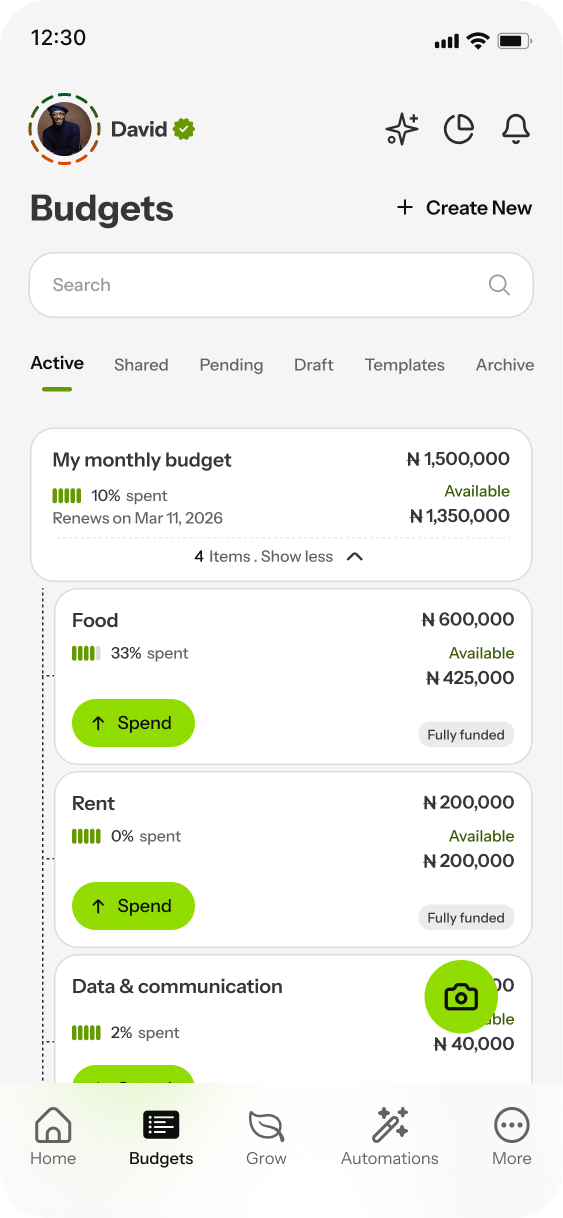
- Create a budget for each purpose. Group the monthly ones, such as "Monthly" with Rent, Food, Transport, Data and Family as sub-budgets.
- Enable Auto-fund on each budget and set the order under Funding priority, so the salary fills your budgets as soon as it arrives.
- Pay transfers and bills from the budget they belong to. Each payment is recorded against its budget, so the tracking happens without a separate log.
- Share a budget where someone else spends for the house, such as groceries. Up to 3 other Delight users can spend from it, and every payment shows who made it under "Spent by".
- Read your Monthly Recap. Early each month, it sums up where the previous month's money went, if you made more than 5 transactions.
Or set it up in one message
Send this to Delight AI in the app. It asks for your amounts, shows every step and waits for your approval.
Help me see where my money goes. Set up budgets for my main spending this month so every payment comes from one of them. Ask me my income and what I usually spend on.
Delight AI is off until you turn it on in Settings › Customize › Delight AI. Anything that sends money out asks for your transaction PIN.
What Delight can’t do
- Delight only sees money that moves through it. Cash and payments from other accounts don't appear in your Delight budgets.
- It won't label your spending as good or bad. It shows which purpose each payment came from; what counts as worth it is your decision.
Questions people ask
- Why am I always broke even though I earn well?
- Higher income often brings higher fixed costs and more people depending on you, while the money still sits in one balance. Without purposes, it goes to whatever asks first. The fix is the same at any income: assign it on payday and pay from those assignments.
- Where does my money go every month?
- Usually into three places people underestimate: small daily payments (food, transport, airtime), money sent to family and friends, and bills that renew quietly. When every payment leaves from a named budget, you can see the answer instead of guessing it.
- How do I find out where my money went last month?
- Go through last month's bank statement and group each payment by purpose: rent, food, transport, family, bills, fun. It's slow once, and it shows your real pattern. In Delight this happens by itself, because each payment already comes from a budget, and the Monthly Recap sums it up.
- How do I stop being broke all the time?
- Stop letting payday money sit unassigned. Fund your fixed costs first, give everyday spending a daily or weekly amount, and keep a small buffer budget for surprises. Being short before payday is usually about timing and visibility, not only income.
For your situation
Read next
Sources
- [1]Thaler, R. H. (1999). Mental accounting matters. Journal of Behavioral Decision Making, 12(3), 183–206.
- [2]Delight Finance (2026). Why people join Delight: onboarding answers, December 2025 to September 2026. Delight Finance insights.
- [3]EFInA (2026). A2F 2026 — report excerpt (web). a2f.ng.Survey findings as published on a2f.ng.
Plan the money. Fund the plan. Spend from the plan.
In Delight, each purpose is a budget that holds its own money, and every payment comes from the budget it serves.