Why your budget keeps failing, and what makes one work
By Samuel Anwakang, Co-founder of Delight•Updated
Most budgets fail because they're written down but never enforced. The plan says ₦60,000 for food, but every naira still sits in one balance, and nothing stops the next payment when the food money is used up. A budget works when each purpose holds its own money and payments come out of that purpose, not out of one balance.
A budget with no power is a wish list
Most people have made a budget. Many made it carefully, on paper, in a notes app or in a spreadsheet. Then the month happened.
What went wrong usually isn't the plan. It's that the plan never touched the money. The budget said ₦60,000 for food. The money stayed in one balance that pays for anything. When the food money was used up, nothing happened. The next payment went through, from money meant for something else.
A written budget records an intention. Wanting to pay rent doesn't pay rent. Psychologists call this the intention–behaviour gap: people often don't do what they fully intend to do.[1]
Why "sometimes" is the most common answer
When people start setting up Delight, we ask whether they budget their money ahead. The most common answer, by far, is "Sometimes".[2] Only one in five say they don't plan at all.
People don't lack plans. A plan that depends on remembering it, checking it and holding back at every payment gets followed sometimes. That isn't a character flaw. It's what happens when a system depends on memory and restraint to work.
The three things a budget needs to work
- Each purpose holds its own money. Rent money isn't in the balance you buy lunch from. When the food budget is empty, the food money is gone, and you can see it. In a field experiment with low-income households, people saved more when earmarked money was split into two accounts than when it was pooled in one.[3]
- Payments come out of the purpose they serve. A transfer for food leaves the food budget, not a general balance. The budget and the money can't drift apart, because they're the same thing. Labels matter: when part of a budget carries a label, people spend it according to the label.[4]
- Something acts before the payment, not after it. A daily allowance, a limit on single payments, or a lock on money that must wait. Tracking tells you afterwards; a control acts at the moment you pay. Self-control research suggests that changing the situation before temptation arrives may be especially effective, more than resisting in the moment.[5]
How Delight gives a budget that power
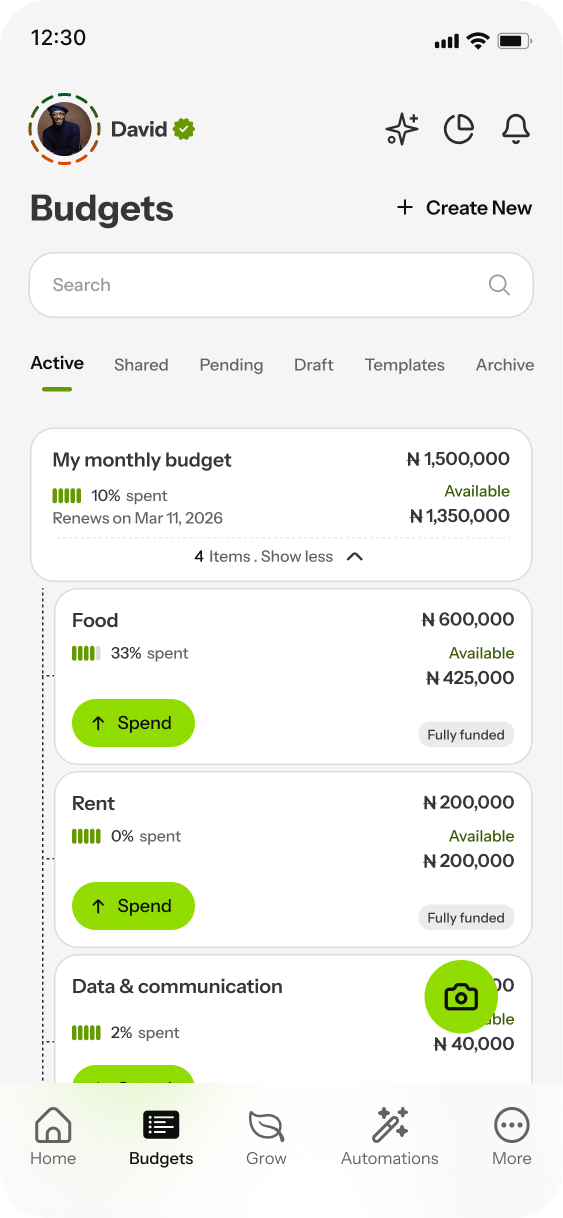
- Budgets hold real money. Each budget in Delight has its own balance. Group related ones, such as "Monthly" with Rent, Food and Data as sub-budgets.
- Money arrives in your wallet, and auto-funding fills your budgets that have Auto-fund enabled, in the order you set under Funding priority. The wallet only funds budgets; every payment comes out of a budget.
- You spend from budgets. Bank transfers, airtime, data, electricity and TV bills are paid from the budget they belong to.
- Drip mode releases a daily or weekly amount from a budget, and only the Available Drip can be spent.
- Spending limits cap single payments or a period's total. You can go over after confirming, with a 5% penalty on the amount above the limit.
- Locks stop all spending from a budget until a set time, on a pattern such as every weekend, or until it's fully funded.
- Every payment is recorded against its budget, so you see where the month went without keeping a separate log.
Or set it up in one message
Send this to Delight AI in the app. It asks for your amounts, shows every step and waits for your approval.
Help me turn my budget into one I can actually spend from. Ask me my income and my budget categories, then create a budget for each one.
Delight AI is off until you turn it on in Settings › Customize › Delight AI. Anything that sends money out asks for your transaction PIN.
What Delight can’t do
- Delight can't choose your amounts. It holds and enforces the plan you make; the plan is still yours.
- Controls can be changed. You can switch off a limit or drip mode, or break a lock early for the penalty you agreed to. They slow a decision down; they don't take it away from you.
- It works on money in Delight. Money in other accounts isn't covered by your Delight budgets.
Questions people ask
- Why can't I stick to a budget?
- Usually because the budget has no hold on the money. It lives in a notebook or an app, while the money sits in one balance that pays for anything. Sticking to it then depends on remembering and holding back at every payment, which is hard to keep up for a whole month.
- How do I actually stick to a budget?
- Move the money, not just the plan. Put each purpose's money in its own place on payday, pay from that place, and add a limit or a daily allowance where you usually overspend. Then the budget is enforced at the moment you pay.
- Does budgeting even work?
- Writing a budget works as a plan. It fails as a control, because a written plan can't stop a payment. Budgets work when the money is separated by purpose and something acts at the point of payment.
- What's the difference between a budget and a spending plan?
- People use the words differently. The useful difference is between a plan that describes the money and a system that holds it. See spending plan vs budget for more.
- What is a spendable budget?
- A budget that holds real money you spend from. In Delight, each budget has its own balance, and transfers and bills are paid from the budget they belong to.
Read next
Sources
- [1]Sheeran, P., & Webb, T. L. (2016). The Intention–Behavior Gap. Social and Personality Psychology Compass, 10(9), 503–518.Setting: Research synthesis.
- [2]Delight Finance (2026). Why people join Delight: onboarding answers, December 2025 to September 2026. Delight Finance insights.
- [3]Soman, D., & Cheema, A. (2011). Earmarking and Partitioning: Increasing Saving by Low-Income Households. Journal of Marketing Research, 48(SPL), S14–S22.Setting: Low-income households (field experiment).
- [4]Abeler, J., & Marklein, F. (2017). Fungibility, Labels, and Consumption. Journal of the European Economic Association, 15(1), 99–127.Setting: Field evidence plus lab experiment.
- [5]Duckworth, A. L., Gendler, T. S., & Gross, J. J. (2016). Situational Strategies for Self-Control. Perspectives on Psychological Science, 11(1), 35–55.
Plan the money. Fund the plan. Spend from the plan.
In Delight, each purpose is a budget that holds its own money, and every payment comes from the budget it serves.