How to lock your money so you can't spend it
By Samuel Anwakang, Co-founder of Delight•Updated
To lock money, move it out of what you spend from and attach a condition to its release: a date, a target or a set period. In Delight you lock the budget itself, so rent money stays in the Rent budget until the date or target you chose. Unlocking early costs a penalty you agree to when you set the lock.
Why money you mean to keep gets spent
Money set aside in the same balance you spend from is protected only by memory and willpower. Every day it's one tap away, and every day something needs it: a friend, a sale, a hard week.
Locking money works because it changes that moment. There's a step and a cost between wanting the money and spending it, and you decided on both earlier, when you were thinking about the purpose, not the temptation.
The evidence is strong. In the Philippines, bank clients were offered a savings account they couldn't withdraw from until a date or a goal they chose. After a year, the group offered it had average savings balances 81 percentage points higher than the group that wasn't.[1] In Kenya, simply giving people a safe place to keep money raised their health savings by 66%.[2]
Nigerians have always known this. Ajo works partly because the money isn't with you. Researchers studying savings groups in Kenya heard members put it simply: you can't save alone.[3] So does leaving money with a parent, or keeping the savings card at home. A lock gives you the same distance without handing your money to anyone.
What a good lock needs, with or without Delight
- A named purpose. "Rent, due 1 March" is easier to protect than "savings".
- A release condition decided in advance: a date, a target amount or a set period.
- A cost for breaking it early. Not so high it traps you in an emergency, not so low it means nothing. The pause, and knowing the cost, is what does the work. In one experiment, higher early-withdrawal penalties sometimes increased, and never reduced, what people chose to put into a locked account.[4]
- Money can still go in. A lock should stop spending, not saving.
- You can see it. Locked money you can see counts as progress. Money hidden in another app is easy to forget, and easy to raid.
How to lock money in Delight
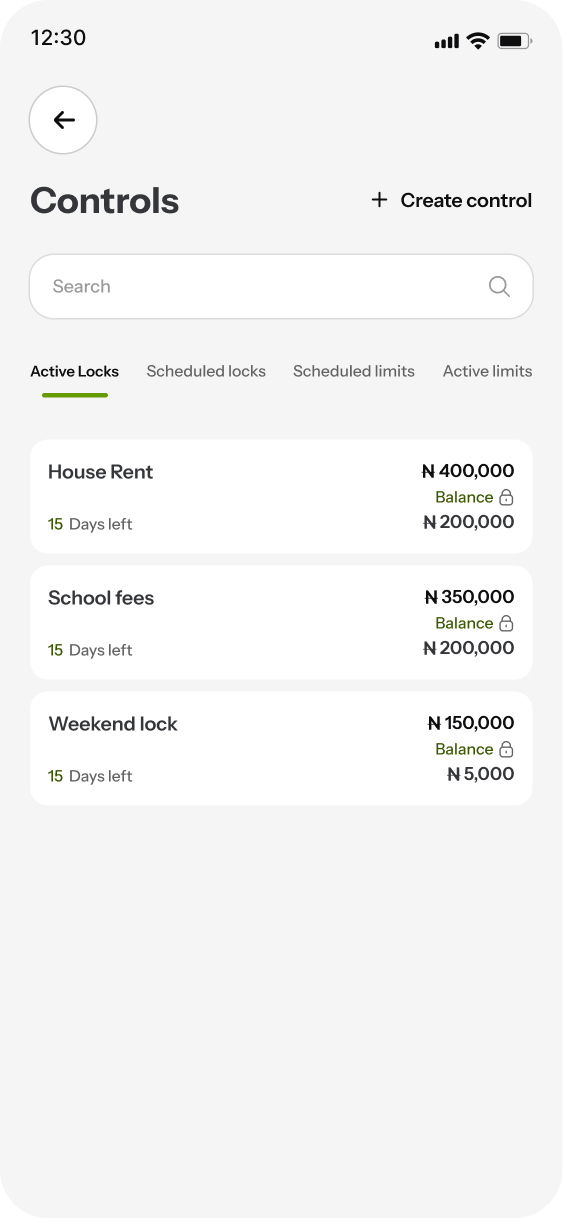
- Create a budget for the money you want to keep, such as Rent, School Fees or Emergency. Locks work on sub-budgets and standalone budgets, not on groups.
- Open the budget and tap Add Control, or go to Hub › Controls, and choose a lock: "Next 24 hours", "Every Weekend", "Every Weekday", "Until Fully Funded" (it opens when the budget reaches its planned amount) or a "Custom Duration" of at least 6 hours.
- Write why this lock matters to you (10 to 200 characters). It's shown on the lock as a reminder.
- Read the terms, tick to agree and swipe to lock. While it's locked, you can't spend from the budget, send from it, move money out, edit it or close it. You can still add money.
- For money you need months from now, use a Stack. A Stack is a savings goal attached to a repeating budget, with a target and a due date. Choose No, lock until due, and a share of every funding moves into it. Closing a locked Stack early costs 5% of its balance.
Or set it up in one message
Send this to Delight AI in the app. It asks for your amounts, shows every step and waits for your approval.
Help me lock money I don't want to touch. Create a budget for it and lock it. Ask me what it's for, how much, and how long to lock it.
Delight AI is off until you turn it on in Settings › Customize › Delight AI. Anything that sends money out asks for your transaction PIN.
What Delight can’t do
- Locked money doesn't earn interest. Delight doesn't pay interest on budgets or Stacks. A lock keeps money for its purpose; it doesn't grow it.
- A lock isn't a vault you can never open. You can unlock early at any time, for the penalty you agreed to: 2% of the budget's balance for timed and repeating locks, 5% for “Until Fully Funded”.
- Scheduled payments won't leave a locked budget. If an automation pays from a budget, plan the lock around it. Delight warns you about 30 minutes before a payment a lock would stop.
Questions people ask
- How do I stop touching my savings?
- Put the savings somewhere you don't spend from, and attach a condition to taking it out: a date, a target, or a cost for breaking it early. A lock with an early-unlock penalty adds a pause and a price between wanting the money and spending it.
- Can I freeze my own savings?
- In Delight you can lock a budget so nothing can be spent, sent or moved out of it until the condition you chose is met. You can still add money while it's locked.
- How long can I lock money in Delight?
- A lock lasts at least 6 hours. On a repeating budget it can last up to 1 month; on a one-time budget, until the budget ends. For money you need further away, such as yearly rent, use a Stack locked until its due date.
- What happens if I need the money urgently?
- You can unlock early. Delight shows the exact penalty before you confirm: 2% of the budget's balance for timed and repeating locks, 5% for “Until Fully Funded”. For a Stack, you can choose when you set it up to allow a limited emergency withdrawal.
- Can I lock money only on weekends?
- Yes. “Every Weekend” locks a budget each Saturday and Sunday, and “Every Weekday” locks it Monday to Friday. The pattern repeats until you stop it.
- Where is my locked money held?
- Delight isn't a bank. Your Delight account number comes from our partner bank, Sterling Bank, and that's where the money in your wallet and budgets is held.
For your situation
Read next
Sources
- [1]Ashraf, N., Karlan, D., & Yin, W. (2006). Tying Odysseus to the Mast: Evidence From a Commitment Savings Product in the Philippines. The Quarterly Journal of Economics, 121(2), 635–672.Setting: Philippines (rural bank clients).
- [2]Dupas, P., & Robinson, J. (2013). Why Don't the Poor Save More? Evidence from Health Savings Experiments. American Economic Review, 103(4), 1138–1171.Setting: Kenya.
- [3]Gugerty, M. K. (2007). You Can’t Save Alone: Commitment in Rotating Savings and Credit Associations in Kenya. Economic Development and Cultural Change, 55(2), 251–282.Setting: Western Kenya.
- [4]Beshears, J., Choi, J. J., Harris, C., Laibson, D., Madrian, B. C., & Sakong, J. (2020). Which early withdrawal penalty attracts the most deposits to a commitment savings account?. Journal of Public Economics, 183, 104144.Setting: US online experiment.
Plan the money. Fund the plan. Spend from the plan.
In Delight, each purpose is a budget that holds its own money, and every payment comes from the budget it serves.