The 50/30/20 Rule in Nigeria: Every Category in Naira, and What the Split Can't Tell You
The 50/30/20 rule splits your take-home pay three ways: 50% for needs, 30% for wants and 20% for savings. It was popularised by Elizabeth Warren and her daughter, Amelia Warren Tyagi, in their 2005 book All Your Worth, written for American households.
Three numbers are a start. But nobody spends in thirds. You spend on rent, food, fares, data and a friend's wedding. This guide breaks each share into the categories a Nigerian salary actually pays for, shows where the rule breaks, and then shows the part most guides skip: why the split alone can't tell you what's happening to your money, and how to see it and change it while the month is still running.
What goes in each share
Start from your net income: what lands in your account after PAYE and pension, not the figure in your offer letter.
Needs: what you can't skip without a consequence
- Rent (the monthly share of a yearly rent)
- Food and market
- Transport to work
- Electricity and cooking gas
- Data and airtime
- Family support you've committed to
- School fees (the monthly share of each term)
- Minimum loan repayments
- Eating out and delivery
- Outings and entertainment
- Owambe, aso-ebi and gifts
- Clothes and personal shopping
- TV and streaming subscriptions
- Hair and personal care beyond the basics
- An emergency fund
- A goal with a date: a phone, a course, land, a move
- Repaying debt faster than the minimum
A ₦300,000 month, category by category
An illustration. Your categories and amounts will differ.
| Share | Category | Amount |
|---|---|---|
| Needs: ₦150,000 | Rent (₦600,000 a year) | ₦50,000 |
| Food and market | ₦45,000 | |
| Transport to work | ₦25,000 | |
| Electricity and cooking gas | ₦12,000 | |
| Data and airtime | ₦6,000 | |
| Family support | ₦12,000 | |
| Wants: ₦90,000 | Eating out and delivery | ₦25,000 |
| Outings | ₦15,000 | |
| Owambe and gifts | ₦15,000 | |
| Clothes and shopping | ₦15,000 | |
| TV and subscriptions | ₦8,000 | |
| Personal care | ₦12,000 | |
| Savings: ₦60,000 | Emergency fund | ₦30,000 |
| A goal with a date | ₦20,000 | |
| Extra debt repayment | ₦10,000 |
Where the rule breaks in Nigeria
- At ₦150,000, needs rarely fit in half. A mini-flat at ₦900,000 a year is ₦75,000 a month on its own: the whole needs share, before food or fares. The rule doesn't fail because anyone is careless. Its 50% was never sized for these costs.
- Some costs don't arrive monthly. Rent is paid a year at a time; school fees come three times a year. They only fit a monthly split if a monthly share is set aside for them.
- Family support is often a need. For many earners it's a fixed obligation, not a want. The rule was written where money mostly belongs to the person who earned it. In Nigeria it often doesn't, and that isn't a flaw in anyone.
- At ₦600,000, the split has room, and a different risk appears. ₦180,000 of wants with no boundary tends to absorb whatever else is loose.
The split shows the totals, not the story
Here's the same ₦300,000 plan at the end of a month. By the rule, it went well:
| Share | Planned | Spent |
|---|---|---|
| Needs | ₦150,000 | ₦153,000 |
| Wants | ₦90,000 | ₦87,000 |
| Savings | ₦60,000 | ₦60,000 |
| Category | Planned | Spent | What actually happened |
|---|---|---|---|
| Transport to work | ₦25,000 | ₦34,000 | Fares went up, and they'll still be up next month |
| Food and market | ₦45,000 | ₦36,000 | Lunches moved to delivery… |
| Eating out and delivery | ₦25,000 | ₦41,000 | …and cost more there |
| Data and airtime | ₦6,000 | ₦9,000 | The line borrowed airtime twice, and the fees came off the next recharges |
| Clothes and shopping | ₦15,000 | ₦0 | A planned purchase was pushed back, for the third month |
None of that is visible in "51/29/20". A ratio is a summary. Decisions happen in categories. Researchers who study budgeting describe the same thing: people set budgets by category and track spending against them, and because no budget anticipates everything, some categories run over while others run under.[1]
And with all your money in one balance, even the category table above takes an evening with a bank statement to build. Most months nobody builds it. All that's left is the feeling that the money finished.
How Delight shows the story while the month is still running
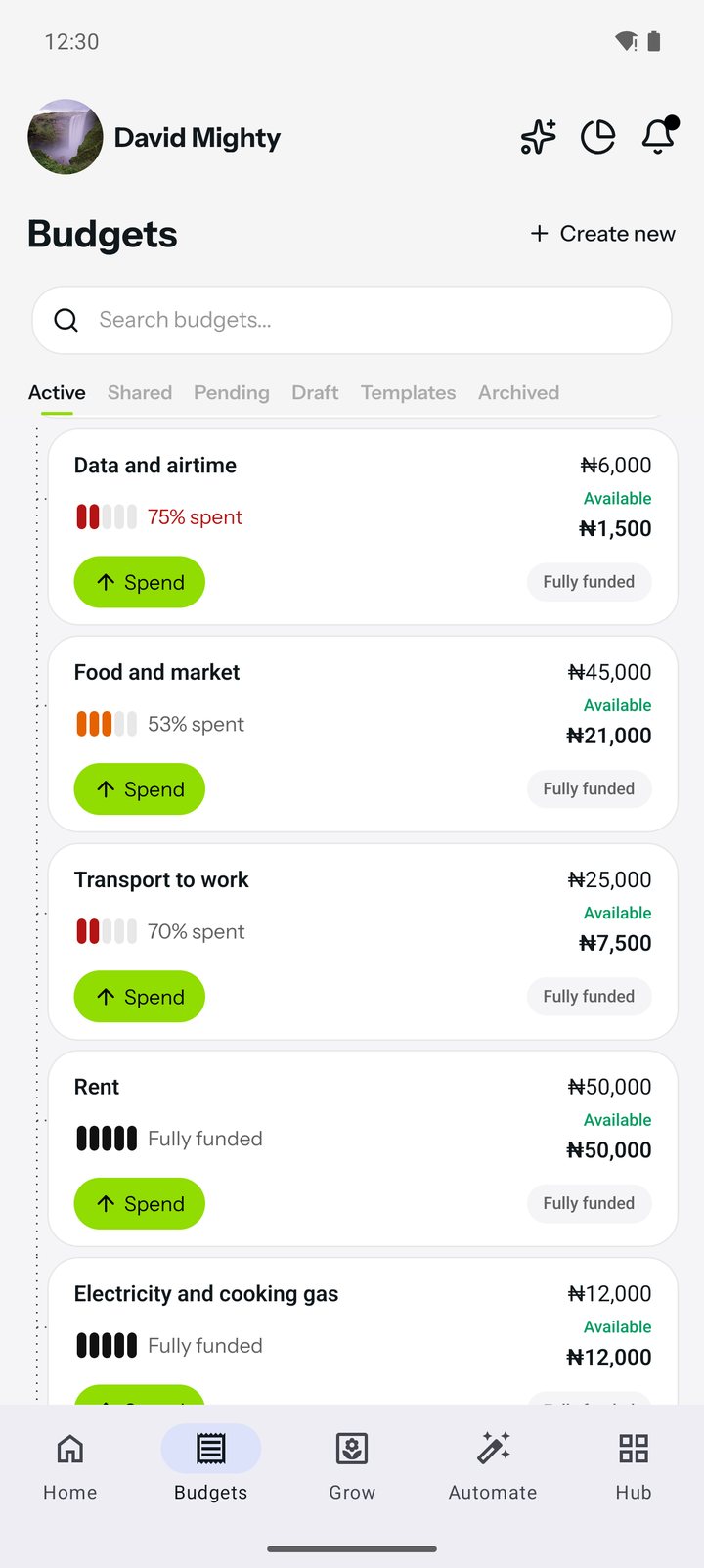
In Delight, the 50/30/20 split becomes real budgets. Needs, Wants and Savings are groups, and every category is a sub-budget with its own money. You get both views at once: the group totals are your three shares, and the sub-budgets are the story inside them.
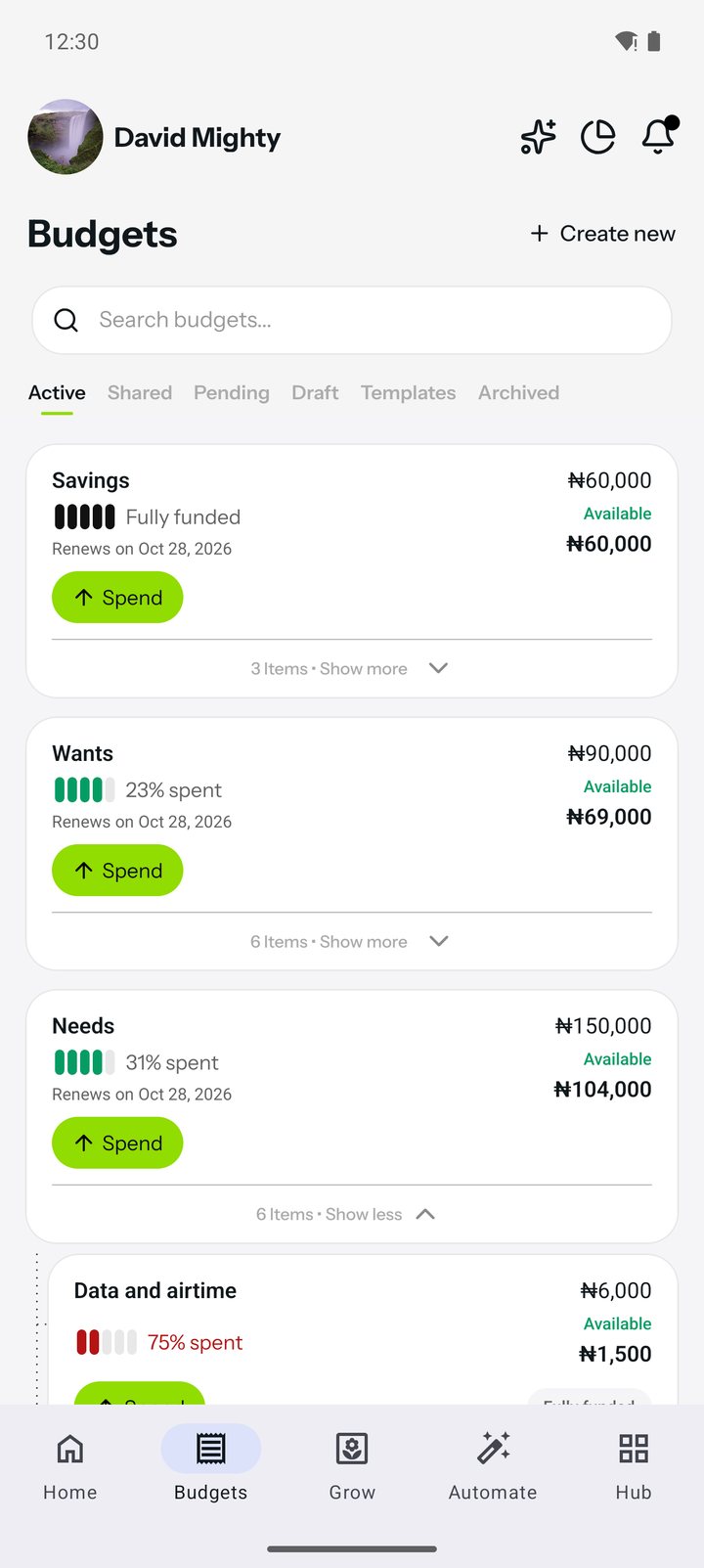
Here's the same month, lived in Delight.
Payday. Your salary lands and auto-funding fills your budgets in the order you set: Needs first, then Savings, then Wants. The Savings budgets feed Stacks for your emergency fund and your goal. Before a single want is bought, the 20% has already gone where it's meant to go.
Every day. You pay each thing from the budget it belongs to: lunch from Food, fuel and fares from Transport, a gift from Owambe and gifts. Each payment is recorded against its budget, so the category table builds itself. There's no spreadsheet to keep.
Day 12: transport shows up early. Your Transport budget is already mostly spent, with more than two weeks to go. You see it in the budget, not in a surprise on the 28th. You can move ₦9,000 into it from Clothes with Reallocate funds, and you choose which purpose gives up the money. Or you ask Delight AI to move it, and approve the change.
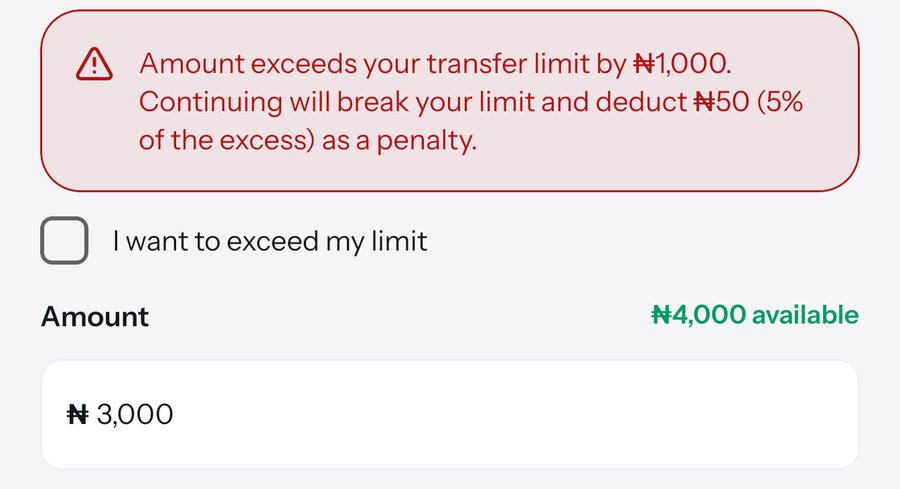
Day 16: the delivery leak meets a boundary. You've put drip mode on Food, so ₦1,500 of food money is available each day and lunch has its own money. On Eating out and delivery, you've set a Per-Transaction Limit of ₦2,000. A ₦3,000 order stops and shows you it's ₦1,000 over the limit, with a ₦50 penalty if you go ahead. You can still choose it, but now it's a choice made at the moment of paying, not a discovery at month end.
Every Monday: the line doesn't borrow. An Airtime & bills automation tops up your phone from the Data budget before it runs out, so there's no empty moment to borrow into. Airtime and data bought through Delight have no charge.
The purchase you keep postponing gets a date. It sits in a Stack on the Clothes budget, with its price as the target, set to unlock when fully funded. It stops competing with everyday spending, because its money isn't in everyday spending.
Month end: the story, in one place. Every budget shows what it planned and what it spent. Early next month, the Monthly Recap sums up where the money went. You can also just ask Delight AI: "How much did I spend on eating out this month?" or "Which budgets did I overspend?" It answers from your own transactions.
Let each month improve the next
The point of seeing the story is changing the plan. In Delight, each change is a setting you make once, not a resolution you have to remember.
| What the month showed | What you change in Delight |
|---|---|
| Transport rose by ₦9,000 | Raise Transport's amount. Take it from Clothes or Outings to keep your shares, or let the shares move: they're a starting point, not a law |
| Lunches drifted into delivery | Drip mode on Food, and a Per-Transaction Limit on Eating out and delivery |
| Wants ran out in the second week | A weekly drip on Outings, or a Period Spending Limit for every weekend |
| The line borrowed airtime | A weekly Airtime & bills automation from the Data budget |
| A purchase kept being postponed | A Stack with its price as the target |
| Savings held | Keep it. When your pay rises, raise the Stack targets before wants grow |
One balance vs. budgets that hold the money
| The problem | With one balance and a plan on paper | With Delight |
|---|---|---|
| Fares rise | You notice when the money runs out | Transport's own balance shows it with weeks to go |
| Food leaks into delivery | You find out, if ever, at month end | A limit stops the order that goes over, at the moment you pay |
| Airtime runs out | You borrow, and repay with fees | A scheduled top-up refills the line first |
| A purchase keeps waiting | It loses to whatever else comes up | It has its own money and a target |
| Savings | Whatever is left at the end | Funded on payday, before wants |
| Where the month went | An evening with a bank statement | Your budgets, the Monthly Recap, or one question to Delight AI |
Set up 50/30/20 in Delight
- Create three groups, Needs, Wants and Savings, with a sub-budget for each category inside them. The group totals are your three shares.
- Give each sub-budget its amount, using the category list above as a starting point.
- Fund needs and savings first. Check that Auto-fund is enabled on each budget, then set the order under Funding priority: Needs, then Savings, then Wants.
- Build savings with Stacks. Add a Stack to your emergency fund and goal budgets, and one on Rent for the yearly rent. Stacks don't pay interest; they keep money for its purpose.
- Put boundaries on the wants that drift: drip mode, a Per-Transaction Limit, or a Period Spending Limit.
- Automate what repeats: data and airtime, electricity, family support.
- Review every month. Read your Monthly Recap, then move amounts between categories to match what really happened.
Frequently Asked Questions
Does the 50/30/20 rule work in Nigeria?
As a starting point, yes. At lower and middle incomes, 50% rarely covers Nigerian needs, and the rule has no place for annual rent or family support unless you give them monthly amounts. It’s most useful as three groups of named categories, each with its own amount.What are needs and wants in a Nigerian budget?
Needs are payments you can't skip without a consequence: rent, food and market, transport to work, electricity and cooking gas, data, committed family support, school fees and minimum loan repayments. Wants are what you choose: eating out and delivery, outings, owambe and gifts, clothes, subscriptions and personal care beyond the basics.How do I know if my 50/30/20 budget is working?
Look at the categories, not the three totals. A month can land at exactly 50/30/20 while fares are rising, food money is leaking into delivery and a planned purchase keeps being pushed back. Compare what each category planned with what it spent, then change the amounts or add boundaries where the story shows a pattern.Where does family support go under 50/30/20?
If it's a regular obligation, treat it as a need and fund it before wants. The rule was written for households where family support is rare; in Nigeria it's often a fixed monthly purpose. See how to support your family without running out of money.How do I budget for annual rent with the 50/30/20 rule?
Divide the annual rent by 12 and set that amount aside every month, before wants, so the full rent is ready when it's due. In Delight, a Stack on your Rent budget builds it towards a due date. See how to save for yearly rent.Is 50/30/20 better than zero-based budgeting?
50/30/20 is simpler; zero-based budgeting is more precise, because every naira gets a specific purpose. In practice, the categories above turn 50/30/20 into something close to zero-based budgeting. Zero-based budgeting in Nigeria shows how to build one.Read next
- Why your budget keeps failing, and what makes one work
Most budgets fail because they're written down but never enforced.
- How to make your salary last till month end
A salary runs out early when the whole month's money is spendable from day one.
Sources
- [1]Heath, C., & Soll, J. B. (1996). Mental Budgeting and Consumer Decisions. Journal of Consumer Research, 23(1).Setting: Consumers.
Plan the money. Fund the plan. Spend from the plan.
In Delight, each purpose is a budget that holds its own money, and you pay from the budget each payment serves.
Download Delight